
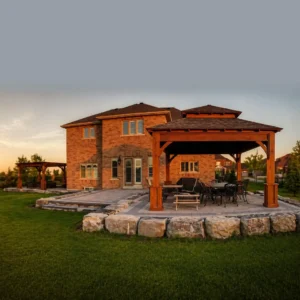
Four-Season Pavilions: Using Your Outdoor Space Through a Canadian Winter
For years, the Canadian backyard followed a predictable rhythm: it opened in late spring, ran hard through summer, and closed down at the first hard




Thousands of Canadian homeowners type “pergola with a roof” into a search bar every year, and most of them are not really looking for a pergola at all. The phrase captures a very specific wish: the open, elegant look of a pergola combined with genuine shelter from rain, sun, and snow. The trouble is that a traditional pergola, by definition, has an open roof, so the term sits in a grey area between two different structures.
Understanding what a pergola with a roof actually refers to saves a lot of confusion and, often, a lot of money. This guide clears up the terminology, explains the difference between a covered pergola and a pavilion, and helps you identify which structure delivers the year-round coverage most Canadians are actually searching for.
A pergola with a roof is a hybrid idea rather than a fixed product, because a true pergola has an open, slatted top designed to filter light rather than block the weather. When people search the phrase, they are usually picturing the clean posts and beams of a pergola with a solid surface overhead that keeps the space dry. In practice, that combination describes one of two things: a covered pergola with an added roofing element, or a pavilion, which is built with a permanent solid roof from the start.
The distinction matters because the two paths perform very differently. Retrofitting a roof onto an open pergola frame can work for light shade or rain, but the structure was not engineered to carry that load, especially under Canadian snow. A pavilion, by contrast, is designed around its roof from the first drawing. So the honest answer to what a pergola with a roof means is that it is shorthand for wanting pergola style with pavilion performance.
A covered pergola is a pergola fitted with a partial or add-on roofing layer, such as slatted louvres, polycarbonate panels, or fabric, while a pavilion is a structure built with a full, permanent, solid roof. The gap between them is coverage and engineering: a covered pergola improves shade and sheds some rain, whereas a pavilion is built to keep a space fully usable in all conditions.
For a mild patio, a covered pergola can be enough. For a Canadian backyard that faces heavy snow loads and freeze-thaw cycles, the calculation changes. Louvred or panel roofs on a pergola frame are rarely rated for serious snow, and the framing beneath them was sized for an open structure rather than a loaded roof. A pavilion is engineered end to end for that weight, which is why homeowners who start by searching for a covered pergola frequently conclude that a pavilion is the structure that actually fits their needs.
Also Read: How to Attach a Timber Frame Pavilion to Your House
The real motivation behind the search is almost always year-round use, because an open pergola simply cannot deliver reliable shelter in our climate. Canadian homeowners want a space that works through summer sun, spring rain, and winter snow, not one that empties out the moment the weather turns. A solid roof is what unlocks that consistency.
That desire for permanence is the thread connecting every “pergola with a roof” search. People want the connected, open-sided feel of a pergola without giving up the protection that makes a space genuinely livable across seasons. Once that underlying need is clear, the choice becomes much easier: the goal is not to force a roof onto a structure that was not built for one, but to choose a structure designed for coverage from the outset. In Canada, that points squarely toward a pavilion.
For most people searching “pergola with a roof,” a timber frame pavilion is the structure that actually matches the vision. It keeps the open sides and clean post-and-beam lines that make pergolas so appealing, then adds a solid, engineered roof built to shed snow and rain and keep the space usable all year. That is the combination the search term is really describing.
A timber frame pavilion from NORWEH is built from Grade No. 1 structural Douglas Fir with mortise and tenon joinery, engineered for Canadian conditions, and finished to age gracefully rather than deteriorate. The Heavy Timber range starts from $9,959 CAD and scales up to larger footprints, with roof styles to suit different backyards. Because the kit arrives pre-cut and engineer-approved, you get genuine heavy timber craftsmanship without the cost and uncertainty of a fully custom build, and a structure that delivers the coverage a covered pergola only partly provides.
Also Read: Custom Timber Frame Kits for Efficient Construction in Canada
You can add a light roofing layer to an existing pergola, but there are real limits, and in Canada those limits arrive quickly. Fabric covers, slatted louvres, and thin polycarbonate panels can improve shade and handle light rain, yet they are seldom rated for snow load, and the original pergola framing was sized for an open structure rather than a roof carrying winter weight.
This is why retrofitting often costs more than expected while delivering less. Upgrading the posts, beams, footings, and roofing to a standard that safely carries Canadian snow can approach the cost of simply building the right structure in the first place. For a homeowner who wants dependable, year-round coverage, choosing a pavilion designed for its roof from the start is usually the more practical and more durable decision than converting a pergola after the fact. If an open-air pergola is what you want, the NORWEH Timber Frame Pergola is built properly for that purpose, and a pavilion is there when coverage is the priority.
The right structure follows directly from how much coverage you need. If you want filtered shade and an open-air room, a pergola is the correct choice. If you want a space that stays dry and usable through every Canadian season, a pavilion is what “pergola with a roof” has been pointing toward all along.
NORWEH Timber Frame offers a purpose-built range to match either goal. For an open, sunlit room, the timber frame pergola is precision-crafted and straightforward to assemble. For full overhead coverage, the Heavy Timber pavilion range offers four roof configurations: the Hip Roof HT, the Double Hip Roof HT, the Two Gable HT, and the Three Gable HT. Every structure is built from Grade No. 1 structural Douglas Fir, arrives pre-cut and engineer-approved, and is backed by free shipping across Canada, a 10-year guarantee, and a 100-day risk-free trial.
If you have been searching for a pergola with a roof, what you are really looking for is pergola style with genuine, year-round coverage, and in a Canadian climate that means a pavilion. A covered pergola can offer partial shelter, but a timber frame pavilion delivers the solid, engineered roof that keeps an outdoor space usable in every season, while keeping the open, elegant lines that drew you to a pergola in the first place.
Explore the full NORWEH timber frame pavilion range to find the roof style and size that turn “pergola with a roof” into a structure built for Canadian conditions.
It is a common search phrase for a structure that combines the open, post-and-beam look of a pergola with a solid roof that provides real shelter. Because a traditional pergola has an open, slatted top, the term usually points to either a covered pergola with an added roofing layer or a pavilion, which is built with a permanent solid roof.
A covered pergola is a pergola fitted with a partial or add-on roof such as louvres, panels, or fabric, while a pavilion is built with a full, permanent, solid roof. A covered pergola improves shade and sheds some rain, whereas a pavilion is engineered to keep a space fully usable in all conditions, including under snow load.
You can add a light roofing layer, but pergola framing is sized for an open structure and is rarely rated for Canadian snow load. Upgrading the posts, beams, footings, and roofing to carry winter weight safely can cost nearly as much as building a pavilion designed for its roof from the start.
Yes. A timber frame pavilion is engineered end to end for snow load, with substantial Douglas Fir framing, proper spacing, and a solid roof built to shed snow and rain. This is what makes it suitable for year-round use across Canadian climates.
A pavilion can cost more upfront than a basic covered pergola, but it delivers full, engineered coverage rather than partial shade. When you account for upgrading a pergola to safely carry snow, a purpose-built pavilion is often the more practical long-term value, with NORWEH’s Heavy Timber range starting from $9,959 CAD.
For years, the Canadian backyard followed a predictable rhythm: it opened in late spring, ran hard through summer, and closed down at the first hard
When a homeowner starts comparing backyard structures, the conversation usually centers on style, size, and price, while the single factor that decides how long the
Planning a backyard upgrade in Canada usually brings homeowners to the same crossroads: a pergola or a gazebo. The pergola vs gazebo question looks simple
It looks like you're visiting from the United States. We have a dedicated US site for you.
Take me to the US site