
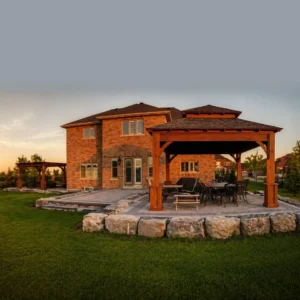
Four-Season Pavilions: Using Your Outdoor Space Through a Canadian Winter
For years, the Canadian backyard followed a predictable rhythm: it opened in late spring, ran hard through summer, and closed down at the first hard



When a homeowner starts comparing backyard structures, the conversation usually centers on style, size, and price, while the single factor that decides how long the structure lasts often goes unmentioned: the grade of the wood itself. Two pavilions can look almost identical in a photo and yet be built from materials that behave very differently under a heavy Canadian snow load or a decade of freeze-thaw cycles. That difference comes down to species and grade, and for structural outdoor building, few materials carry the reputation of Douglas Fir wood.
The trouble is that “Douglas Fir” on a product page tells you the species but not the quality, and quality is exactly what determines whether a beam holds its line for thirty years or begins to sag and split. This is where grading matters, and where a term like “No. 1 grade” moves from marketing language to a measurable standard. This guide explains what Douglas Fir wood is, what a No. 1 structural grade actually certifies, and why that grade is the right foundation for a backyard structure meant to stand for decades.
Douglas Fir wood is a dense, high-strength softwood prized as one of North America’s premier structural building materials. It grows across the western part of the continent, including the forests of British Columbia and the wider Pacific Northwest, and it has long been the species of choice where strength-to-weight performance and dimensional stability matter most.
The reason builders reach for it is straightforward. Douglas Fir carries some of the highest design values among commonly available softwoods, which means it resists bending and carries load better than lighter species of the same size. It also holds its shape well as it dries, takes a protective finish cleanly, and ages into a warm, characterful grain rather than a flat, uniform surface. For an exposed post-and-beam structure, where the timber is both the frame and the finished look, that combination of structural capacity and natural appearance is difficult to match. It is the same species specification used in residential and commercial construction, which is precisely why it belongs in a backyard structure expected to perform like permanent architecture.
No. 1 grade is a structural quality classification that sits near the top of the visual grading scale, above the more common grades used in everyday framing. Structural softwood lumber is sorted into a defined ladder of grades, from Select Structural at the top, down through No. 1, No. 2, and No. 3, with each step allowing progressively more natural characteristics that reduce strength.
What a grader is really assessing is how much a piece of timber’s natural features affect its load-bearing capacity. Every board is inspected against limits on knot size and soundness, slope of grain, wane (the bark edge of the log), and the size of splits and shakes. A No. 1 piece permits only tight, sound, well-spaced knots within strict size limits and a straighter grain than lower grades allow, because both knots and grain deviation are where a beam is most likely to fail under stress. Crucially, these grades are stress-rated: each carries published design values that engineers use to predict exactly how much load the timber can safely carry. So when a structure is specified as No. 1 structural Douglas Fir wood, it is not a description of appearance alone, it is a certified strength standard that a beam has been individually checked against.
In Canada, structural lumber is graded under the National Lumber Grades Authority, the body that publishes the Standard Grading Rules for Canadian Lumber. Every piece of dimension and structural timber is assessed, either by a trained visual grader or by machine, against the permitted characteristics for its grade, and Douglas Fir falls within the Douglas Fir-Larch group, one of the strongest structural softwood groupings recognized in those rules.
This standardized system is what gives a grade its meaning. Because the rules are consistent and enforced, a No. 1 designation carries the same structural promise from one supplier to the next, which is what allows engineers to design confidently around it. It is also worth understanding one natural feature that surprises first-time timber owners: seasoning checks. As solid timber dries and settles into its environment, fine surface cracks known as checks can develop along the grain. These are a normal, permitted characteristic of authentic solid wood and do not compromise the structural integrity of the frame, which is why they appear even in high grades and are considered part of the character of real timber rather than a defect.
Also Read: Custom Timber Frame Kits for Efficient Construction in Canada
For a backyard structure, the grade of the Douglas Fir wood is the difference between a frame engineered to carry real load and one that simply looks the part. Canadian conditions are demanding in a way that lightweight seasonal shade products are not built for: sustained snow loads through winter, wind that drives against tall open structures, freeze-thaw cycles that work at every joint, and summer UV that breaks down unprotected surfaces.
A No. 1 structural grade gives the engineering headroom to meet those conditions rather than approach their limits. Heavier, higher-graded timber holds its span under the weight of accumulated snow, keeps its line over years of seasonal movement, and provides the mass that anchors a structure against wind. This is where the material choice becomes a performance choice. Every NORWEH structure, including the Hip Roof Timber Frame Pavilion HT, is built from Grade No. 1 structural Douglas Fir, joined with traditional mortise-and-tenon joinery and protected with CUTEK stain for long-term resistance to UV and moisture. The hip roof configuration in particular is engineered as the strongest option for high-wind and heavy-snow settings, which shows how grade and design work together to deliver durability rather than relying on the wood alone.
For a structure you intend to keep for decades, No. 1 structural Douglas Fir is the grade that justifies the investment, because it protects the two things that matter most over time: safety under load and appearance under exposure. A lower grade can look acceptable on day one, but the compromises that lower grades permit, larger knots, looser grain, and greater movement, are exactly the features that show up as sagging, splitting, and premature ageing once the structure has weathered a few Canadian seasons.
NORWEH Timber Frame builds its full range on this single material standard, so the choice is not whether you get No. 1 structural Douglas Fir but which configuration suits your property. For an accessible, residential-scale option, the Pavilion LT is precision-crafted and straightforward to assemble. For greater architectural presence and larger spans, the Heavy Timber pavilion range offers four roof styles, including the Two Gable HT, with Heavy Timber pricing starting from $12,509 CAD. Every kit arrives pre-cut, pre-stained, and engineer-approved and is backed by free shipping across Canada, a 10-year guarantee, and a 100-day risk-free trial. Framed against a structure meant to last a generation, the higher grade is not a premium add-on; it is the reason the structure lasts.
Also Read: Footings & Foundations: The Key to a Strong Timber Frame Pavilion or Pergola
The grade printed alongside a species is where a backyard structure’s long-term story is really written, and No. 1 structural Douglas Fir wood is the standard that turns a good-looking frame into a lasting one. It certifies the strength to carry Canadian snow and wind, the stability to hold its line for decades, and the natural character that makes exposed timber worth showing. If you are weighing a structure built to perform as permanent architecture, explore the full NORWEH timber frame pavilion range to find the configuration that fits your property.
Frequently Asked Questions
No. 1 grade is a structural quality classification that sits near the top of the visual grading scale, above the common grades used in everyday framing. It limits knot size, slope of grain, and wane so that the timber meets a certified, stress-rated strength standard with published design values engineers can build around.
Yes. Douglas Fir is one of the strongest and most dimensionally stable softwoods available, which makes it well suited to load-bearing outdoor structures. When it is graded No. 1 structural and protected with a quality finish such as CUTEK stain, it performs reliably through heavy snow, wind, and freeze-thaw cycles.
In Canada, structural lumber is graded under the National Lumber Grades Authority using the Standard Grading Rules for Canadian Lumber. Each piece is assessed, visually or by machine, against defined limits on knots, grain, wane, and other characteristics, and Douglas Fir is graded within the strong Douglas Fir-Larch species group.
No. Fine surface cracks known as checks develop naturally as solid timber dries and adjusts to its environment. They are a normal, expected characteristic of authentic solid wood and do not affect the structural integrity of the frame.
Yes. A higher structural grade like No. 1 provides more engineering headroom to carry snow and wind loads and resist long-term movement. Over decades of Canadian weather, that translates into a frame that holds its shape and appearance rather than sagging, splitting, or ageing prematurely.
For years, the Canadian backyard followed a predictable rhythm: it opened in late spring, ran hard through summer, and closed down at the first hard
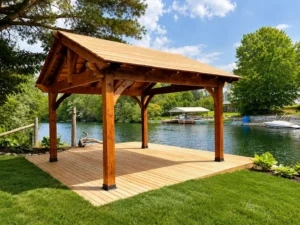
When a homeowner starts comparing backyard structures, the conversation usually centers on style, size, and price, while the single factor that decides how long the
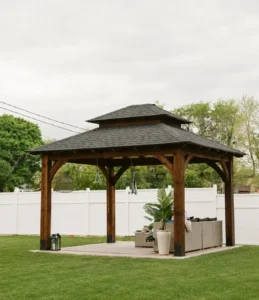
Planning a backyard upgrade in Canada usually brings homeowners to the same crossroads: a pergola or a gazebo. The pergola vs gazebo question looks simple
It looks like you're visiting from the United States. We have a dedicated US site for you.
Take me to the US site