
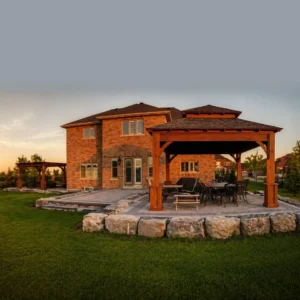
Four-Season Pavilions: Using Your Outdoor Space Through a Canadian Winter
For years, the Canadian backyard followed a predictable rhythm: it opened in late spring, ran hard through summer, and closed down at the first hard



For years, the Canadian backyard followed a predictable rhythm: it opened in late spring, ran hard through summer, and closed down at the first hard frost. That rhythm is changing. Across the 2026 outdoor living trend reports coming out of Ontario, Quebec, and beyond, the same shift keeps surfacing: homeowners are no longer content to lose their outdoor space for nearly half the year, and features like wind protection, radiant heat, and season-extending design have moved from luxury to expectation.
The obstacle has never been the Canadian winter itself; it has been the structure. A retractable awning, a fabric canopy, or an open pergola offers no real defence against snow load and driving wind, so the space underneath them simply becomes unusable once the temperature drops. Making outdoor living in Canada a genuine four-season proposition starts with a permanent structure engineered for the season most backyards surrender to. This guide explains what turns a pavilion into a true four-season space, and how to keep it warm, sheltered, and usable through a Canadian winter.
Yes, you can use an outdoor space comfortably through a Canadian winter, provided the structure at its centre is built for the conditions rather than around them. The defining outdoor living trend heading into 2026 is exactly this: extending the usable season instead of accepting a summer-only backyard, and the reports converge on the same enablers, overhead cover that sheds snow, screening that blocks wind, and a heat source that a solid roof makes practical.
The reason this now works comes down to the structure doing the heavy lifting. A permanent, fully roofed pavilion creates a defined pocket of protected space, and once you have that, winter use becomes a question of comfort rather than survival. Snow stays off the seating area, wind is broken before it reaches you, and heat has something to gather under. The outcome is a backyard that keeps earning its place in the coldest months, hosting a Sunday morning coffee by the fire, a small winter gathering, or a quiet evening under the stars while snow settles on the roof above.
A true four-season pavilion is defined by a solid, load-bearing roof and a frame engineered to carry winter loads, which is what separates it from seasonal shade products. The single most important feature is a full roof deck that sheds snow and keeps the space beneath it dry and clear, rather than an open lattice or fabric top that collects weight and offers no shelter.
That capability depends on how the structure is built from the ground up. NORWEH pavilions are constructed from heavy timber with a full solid roof deck, engineered to handle significant snow loads, and set on footings placed below the frost line, typically around four feet down, so the ground beneath stays stable through freeze-thaw cycles instead of shifting or heaving. The final waterproofing is completed with the roofing material you choose, such as metal panels, shingles, or cedar shakes, with metal being a popular choice in snow country for the way it sheds accumulation. Built this way, the pavilion is not a fair-weather addition that you protect from winter, it is a permanent structure that treats winter as one of the four seasons it was designed to work in.
You keep a winter pavilion comfortable by combining wind protection with a heat source, and a solid roof is what makes both effective. In an open or fabric-topped structure, heat rises straight out and wind cuts through unimpeded, which is why those spaces fail in winter; under a fully roofed pavilion with the sides addressed, warmth has something to hold onto.
Wind protection is the first move, because wind, not temperature alone, is what drives people indoors. Enclosing one or two bays with a solid screen blocks the prevailing wind and creates the sheltered, intimate pocket where a winter evening actually becomes pleasant. The NORWEH Privacy Wall is built for exactly this, crafted from the same premium Douglas Fir and CUTEK stain as the pavilion, and it installs into an existing bay at any time, so you can add wind protection to a structure you already own without modifying the original build. With the wind handled, a heat source does the rest: patio heaters, a fire feature, or radiant heat all work well under a solid roof, and many owners going all-in on winter use add radiant or heated flooring, one of the standout features in the 2026 trend reports, to turn the space into a genuine cold-weather room.
Also Read: Outdoor Living: Canadian Backyard Ideas
Yes, a NORWEH timber frame pavilion is engineered from structural-grade Douglas Fir to handle significant snow loads and wind forces, which is the entire premise of a four-season structure. In Canada, that engineering is not optional, it is the difference between a roof you trust through February and one you worry about after every storm.
The strength comes from the material and the design working together. Every structure is built from Grade No. 1 structural Douglas Fir, joined with mortise-and-tenon joinery for real structural weight, and the roof geometry is matched to the conditions. The Hip Roof Timber Frame Pavilion HT is engineered as the strongest option for high-wind and heavy-snow regions, with slopes on all four sides that shed load evenly and present less resistance to wind. It is worth noting that as heavy timber dries, fine surface cracks called checks may appear along the grain; these are a normal characteristic of solid wood and do not affect structural integrity. Combined with footings set below the frost line, the result is a structure that stays put, stays sound, and carries a Canadian winter the way it was designed to.
The right pavilion for year-round use is the one whose size and roof style match how you plan to use the space through winter, and NORWEH offers a purpose-built range to suit different properties and budgets. For an accessible, residential-scale structure, the Pavilion LT is precision-crafted and straightforward to assemble. For greater architectural presence and the scale that suits winter entertaining, the Heavy Timber pavilion range offers four roof configurations: the Hip Roof HT, the Double Hip Roof HT, the Two Gable HT, and the Three Gable HT, with Heavy Timber pricing starting from $11,105 and scaling with size from 10×10 up to 24×36.
For committed four-season use, two considerations guide the choice. First, favour a footprint with room for both a seating zone and a heat source, since a slightly larger structure holds warmth and function far better in winter. Second, consider the hip roof if wind and snow are significant at your site, and plan for one or more privacy walls to enclose the space. Every kit arrives pre-cut, pre-stained, and engineer-approved, and is backed by free shipping across Canada, a 10-year guarantee, and a 100-day risk-free trial, so you can plan a genuinely year-round backyard with the durability details already handled.
Also Read: Footings & Foundations: The Key to a Strong Timber Frame Pavilion or Pergola
Outdoor living in Canada has outgrown the summer-only backyard, and a four-season pavilion is what makes the shift real, turning the season most homeowners surrender into one they actually use. The through-line is simple: a permanent, engineered structure sheds the snow, breaks the wind, and holds the heat, and everything comfortable about a winter evening outdoors follows from that. To plan a backyard that works in every season, explore the full NORWEH timber frame pavilion range and find the configuration built for your property and your winters.
Yes. A permanent, fully roofed timber frame pavilion is designed for year-round use, including a Canadian winter. Its solid roof sheds snow and keeps the space dry, and once you add wind protection and a heat source, the area beneath stays comfortable through the coldest months.
A four-season pavilion has a solid, load-bearing roof and a frame engineered to carry winter snow and wind, set on footings placed below the frost line. This separates it from seasonal shade products like fabric canopies or open pergolas, which collect snow weight and offer no real shelter.
A solid roof is what makes heating an outdoor pavilion practical, because it holds warmth in rather than letting it escape. Owners commonly combine wind protection, such as an enclosed bay or privacy wall, with patio heaters, a fire feature, or radiant and heated flooring to create a comfortable cold-weather space.
Yes. NORWEH timber frame pavilions are engineered from Grade No. 1 structural Douglas Fir to handle significant snow and wind loads, with the hip roof being the strongest option for high-wind and heavy-snow regions. Footings set below the frost line keep the structure stable through freeze-thaw cycles.
NORWEH Heavy Timber pavilions start from $9,959 CAD and scale with size and roof configuration. An accessible Pavilion LT option is also available, and every kit includes free shipping across Canada, a 10-year guarantee, and a 100-day risk-free trial.
For years, the Canadian backyard followed a predictable rhythm: it opened in late spring, ran hard through summer, and closed down at the first hard
When a homeowner starts comparing backyard structures, the conversation usually centers on style, size, and price, while the single factor that decides how long the
Planning a backyard upgrade in Canada usually brings homeowners to the same crossroads: a pergola or a gazebo. The pergola vs gazebo question looks simple
It looks like you're visiting from the United States. We have a dedicated US site for you.
Take me to the US site