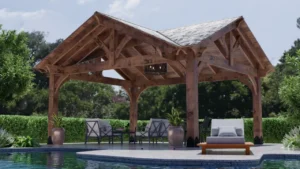
How to Attach a Timber Frame Pavilion to Your House: Complete Guide
Many homeowners love the idea of spending more time outdoors, but Canadian weather, limited space and disconnected patios often make backyards feel underused. A timber

One winter is all it takes. Heavy snowfall settles in, temperatures swing wildly, and suddenly that backyard structure you loved in summer starts to sag, shift, or crack. Many homeowners discover too late that their gazebo structure was never designed for real Canadian weather.
This is where pavilions stand apart. A pavilion built with durable materials and a properly engineered pavilion foundation is designed to handle snow loads, frost movement, and long winters without constant repairs. If your goal is a structure that survives not just looks good, winter performance matters more than ever.
Canadian climates are unforgiving to outdoor structures that rely on light framing or shallow foundations. When winter performance isn’t considered at the design stage, problems become inevitable. A pavilion addresses these challenges upfront by prioritizing structural strength, stability, and long-term resilience.
Yes, a pavilion is better suited for heavy snowfall because it is engineered for load-bearing strength. Most gazebo structures are lightweight and decorative, meaning snow tends to accumulate rather than shed off the roof. Over time, this added weight creates structural stress.
Pavilions use steeper roof pitches, thicker beams, and intentional load distribution. Combined with a stable pavilion foundation, this design allows snow to slide off naturally, reducing strain and extending the life of the structure in Canadian winters.
This difference becomes most visible during prolonged snow events. While gazebo roofs often require manual snow removal to prevent damage, a properly designed pavilion manages snow passively, reducing risk and minimizing the need for constant winter intervention.
A gazebo structure is typically designed for shade and mild weather, not months of snow and freeze-thaw cycles. Shallow footings and lighter framing make gazebos vulnerable to frost heave and prolonged snow loads.
People often ask, “Can a gazebo be reinforced for winter?” While small upgrades may help, they don’t change the core design limitations. Without durable materials and a reinforced pavilion foundation, gazebos struggle to perform reliably in harsh Canadian climates.
The issue is not just strength, but design intent. Gazebos are often manufactured for broad markets with mild climates in mind. As a result, they lack the structural redundancy and foundation depth required to withstand Canadian winter conditions year after year.
The best pavilions are built using durable materials that resist moisture, temperature swings, and long-term exposure to snow and ice. Douglas fir stands out for its exceptional strength, dimensional stability, and ability to perform reliably in harsh Canadian conditions, making it an ideal choice for long-lasting pavilion structures.
A frequent buyer question is, “Do stronger materials really matter?” The answer is yes. Durable materials prevent warping, cracking, and rot, especially under heavy snowfall, and help the pavilion maintain structural integrity long after many gazebo structures begin to deteriorate.
Material selection directly impacts how a structure ages. When snow loads and moisture are constant factors, weaker materials fail gradually but consistently. Choosing proven, durable materials ensures the pavilion remains structurally sound and visually intact over decades, not just a few seasons.
The pavilion foundation is critical because it keeps the structure stable as the ground freezes and shifts. In Canada, frost heave can move shallow footings enough to misalign posts or stress roof connections.
People also ask, “Can a pavilion be installed without concrete footings?” In snowy regions, a reinforced pavilion foundation is strongly recommended. Proper footings or slabs prevent movement, protect the structure, and ensure long-term performance through repeated winter cycles.
Without a proper foundation, even the strongest pavilion materials are compromised. Structural movement at ground level transfers stress upward, affecting joints, beams, and roofing. A well-engineered pavilion foundation prevents these issues before they start.
Yes, pavilion design plays a major role in snow management. Roof pitch, overhang length, and beam spacing can all be optimized to reduce snow accumulation. This level of customization is rarely possible with a standard gazebo structure.
Homeowners often wonder, “Will a snow-rated pavilion look bulky?” Not at all. With smart proportions and durable materials, a pavilion can remain open and elegant while still handling heavy snowfall efficiently.
Snow management is most effective when it is built into the design rather than added later. By planning for snow load behavior from the start, a pavilion can maintain both structural performance and visual balance throughout the winter months.
A pavilion requires less winter maintenance than a gazebo structure because it is designed to manage snow loads more effectively. Occasional snow removal after major storms and annual inspections are usually sufficient.
A common question is, “Do pavilions last longer than gazebos?” Yes. When built with durable materials and supported by a strong pavilion foundation, pavilions experience less structural stress and typically last far longer in Canadian conditions.
Reduced maintenance is a direct result of proper design and construction. When snow loads, moisture, and frost movement are accounted for upfront, homeowners spend less time fixing problems and more time enjoying their outdoor space.
Also Read: Timber Frame Structures: Professional Engineering for All Weather Conditions
Most outdoor structure failures stem from design decisions made before construction, not from material defects. When snow load, frost depth, and temperature variation are treated as secondary, weaknesses are built in and typically exposed after the first Canadian winter.
A pavilion designed for Canadian conditions accounts for winter performance from the start. Roof pitch, beam sizing, connections, and foundations are engineered to handle snow, ice, and ground movement, with clear load paths that prevent deformation and joint failure.
Gazebos are usually based on standardized designs for mild climates and lack this level of engineering. Designing for winter from day one creates a durable, long-term structure instead of an ongoing maintenance problem.
Also Read: Why Choose Douglas Fir for Your Outdoor Pavilion?
Canadian winters expose weak designs fast. Heavy snowfall, shifting ground, and freezing temperatures push outdoor structures to their limits, and gazebo structures often fall short. Pavilions are designed differently, with strength and longevity built in from the start.
By choosing durable materials and investing in a proper pavilion foundation, you create a structure that performs reliably year after year. If you want a backyard space that holds up through real Canadian weather, a pavilion is the smarter long-term solution.
When winter performance is engineered from the outset, the difference is obvious. A well-built pavilion isn’t just winter-resistant, it’s designed to perform reliably through Canadian conditions.
Many homeowners love the idea of spending more time outdoors, but Canadian weather, limited space and disconnected patios often make backyards feel underused. A timber
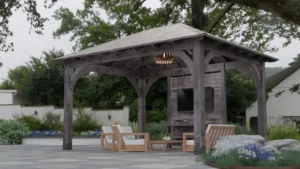
Outdoor living in Canada continues to evolve beyond seasonal patios and temporary shade solutions. Homeowners are increasingly approaching backyard upgrades as a full backyard makeover,
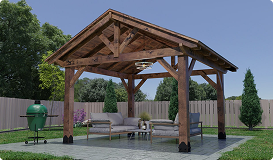
One winter is all it takes. Heavy snowfall settles in, temperatures swing wildly, and suddenly that backyard structure you loved in summer starts to sag, shift, or crack. Many homeowners discover too late that their gazebo structure was never designed for real Canadian weather.