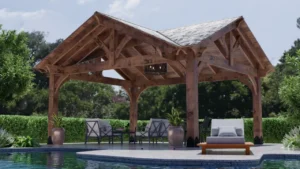
How to Attach a Timber Frame Pavilion to Your House: Complete Guide
Many homeowners love the idea of spending more time outdoors, but Canadian weather, limited space and disconnected patios often make backyards feel underused. A timber

When homeowners start planning an outdoor shade structure, gazebos and pavilions are often treated as interchangeable terms. At a glance, both offer shelter from the sun and rain. In reality, they serve very different purposes and deliver very different long-term values.
As outdoor living becomes a core part of Canadian home design, from backyard kitchens to year-round entertaining spaces, choosing the wrong structure can limit how your space functions and how much value it adds to your home.
This guide breaks down the real difference between a gazebo and a pavilion, explains how these differences affect daily use, and helps you decide which option aligns with your lifestyle and property goals.
Before comparing features, it’s important to define what each structure is designed to do.
A gazebo is traditionally a decorative, freestanding structure, often placed as a focal point in a garden or yard. Its purpose is visual appeal and intimate seating rather than large-scale use.
A pavilion, on the other hand, is designed as a functional outdoor room. It is built to cover usable space, accommodate furniture and appliances, and integrate seamlessly with patios, pools, or decks.
This difference in intent drives every design and performance distinction between the two.
| Feature | Traditional Gazebo | Modern Pavilion (NORWEH Timber Frame Focus) |
| Shape | Octagonal, hexagonal, or round | Rectangular or square |
| Sides | Partially or fully enclosed with railings or panels | Open-sided with strong vertical posts |
| Size | Typically 8–12 feet | Large spans, often 12–40+ feet |
| Roof Type | Decorative or lightweight | Permanent, engineered hard roof |
| Primary Purpose | Visual focal point, small seating area | Outdoor dining, kitchens, entertaining, lounging |
| Design Style | Traditional, ornate | Clean, modern, architecturally integrated |
One of the biggest differences in the gazebo vs pavilion comparison is how efficiently the space can be used.
Gazebos are limited by their shape. Octagonal and circular layouts make furniture placement awkward, leaving wasted corners and restricting movement. Railings and partial enclosures further reduce usable square footage.
Pavilions use rectangular or square footprints, which align naturally with:
The result is a space that feels open, balanced, and easy to design around, similar to an indoor room, but outdoors.
Gazebos often include railings, lattice, or screened panels. While this can create privacy, it also blocks airflow and sightlines, especially during warm summer months.
Pavilions are intentionally open on all sides, supported only by posts or columns. This design:
For homeowners who entertain frequently or cook outdoors, this openness is essential for comfort and usability.
Durability is where the gap between gazebos and pavilions become especially clear.
Many gazebos, particularly kit-based models, use lightweight materials or fabric roofs. These require ongoing maintenance, seasonal removal, and offer limited protection in heavy rain, wind, or snow.
A true pavilion, such as those built by NORWEH Timber Frame, are engineered as a permanent structure. These are designed to handle:
This makes a pavilion a safer and more reliable solution for homeowners in Canada dealing with varied and extreme weather conditions.
Gazebos are often marketed as quick-install solutions. While that may seem appealing upfront, it usually comes with trade-offs:
Pavilions require proper installation but demand far less ongoing upkeep when built with high-quality materials.
NORWEH Timber Frame Pavilions are crafted using low-maintenance materials such as durable vinyl and high-grade aluminum, which resist:
Over time, this translates to lower ownership costs and more time enjoying the space.
From an investment perspective, gazebo vs pavilion is not a close comparison.
Gazebos are typically treated as decorative or personal property. They rarely factor into home appraisals and offer minimal resale advantage.
Pavilions, when professionally constructed, are often recognized as covered outdoor living space. This can:
As outdoor living continues to influence buyer decisions, this distinction becomes increasingly important.
Traditional gazebos feature ornate details and classic silhouettes that don’t always align with modern or contemporary home architecture.
Pavilions offer clean lines, strong columns, and minimalist forms that integrate naturally with:
Instead of standing apart as a decorative element, a pavilion feels like a seamless extension of the home itself.
If your goal is a decorative centerpiece or a quiet seating nook, a gazebo can still serve that purpose.
However, between the gazebo vs pavilion comparison, the pavilion is the clear choice if you want to:
Understanding the difference is only the first step. The right pavilion design depends on your yard size, climate, and how you plan to use the space.
Read next: How to Choose a Gazebo or Pavilion for Your Yard
Many homeowners love the idea of spending more time outdoors, but Canadian weather, limited space and disconnected patios often make backyards feel underused. A timber
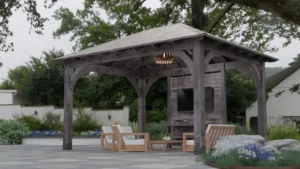
Outdoor living in Canada continues to evolve beyond seasonal patios and temporary shade solutions. Homeowners are increasingly approaching backyard upgrades as a full backyard makeover,
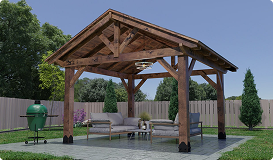
One winter is all it takes. Heavy snowfall settles in, temperatures swing wildly, and suddenly that backyard structure you loved in summer starts to sag, shift, or crack. Many homeowners discover too late that their gazebo structure was never designed for real Canadian weather.