
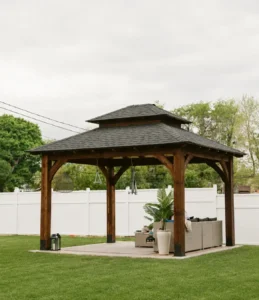
Pergola vs. Gazebo: Which One Actually Fits a Canadian Backyard
Planning a backyard upgrade in Canada usually brings homeowners to the same crossroads: a pergola or a gazebo. The pergola vs gazebo question looks simple




For anyone approaching a first outdoor build in Canada, the choice between a DIY pavilion built from raw materials and a pavilion kit is one of the earliest and most consequential decisions of the project. Both paths lead to the same outcome on paper. The planning requirements, skill demands, and build experience, however, differ considerably.
In Canada, where build seasons are short and permit requirements vary by province, that distinction has a direct impact on whether a first build finishes on time and to standard.
Constructing a DIY pavilion from raw materials requires sourcing structural lumber, obtaining engineering plans, cutting every component to dimension, and sequencing the build without a pre-engineered system. Each stage introduces decisions that carry consequences for the stages that follow.
Canadian conditions add further complexity. Footings must extend below the regional frost line, beam dimensions must account for snow loads, and structures above a certain footprint typically require a building permit supported by engineer-reviewed drawings.
The appeal of a scratch build is legitimate, offering complete design flexibility and full control over specification. For a first-time builder, however, the most demanding part is often not the physical construction but the weeks of planning and technical decision-making that precede it.
A pavilion kit arrives factory-cut, labelled, and finished to specification, with beams, posts, rafters, hardware, and pre-machined joinery included. The builder receives a complete, engineered system rather than raw materials requiring interpretation.
Mortise and tenon joints are pre-cut to precise tolerances. Beam dimensions are calculated for Canadian snow load requirements. The assembly sequence is designed for two people with standard tools and no prior timber frame experience.
A structure that would take a first-time builder three to four weekends to plan and frame from raw lumber can typically be assembled in a single weekend with a pavilion kit and two people. For most first-time builders, that represents the difference between a completed project and one that extends well beyond the season it was intended to serve.
A DIY pavilion from scratch requires a complete set of structural plans before site work begins, covering post sizing, beam dimensions, footing depth, and setback requirements. In most Canadian provinces, structures above a threshold footprint require a permit, and many municipalities will not issue one without engineer-reviewed documentation.
A pavilion kit arrives with this planning already completed. Engineer-approved designs address Canadian climate requirements, and permit documentation is available for municipalities that require it. The planning phase reduces to site assessment, footing preparation, and following the assembly sequence.
For a first-time builder without a construction background, this gap is significant. A scratch build requires structural competency before physical work can begin. A pavilion kit transfers that responsibility to the manufacturer and allows the builder to focus on assembly.
A scratch-built DIY pavilion requires a circular saw, miter saw, post hole digger, framing square, level, and drill, along with the ability to read structural plans and make accurate cuts in large-format lumber. Errors in beam cutting or post placement affect the entire frame and are difficult to correct once framing is underway.
A pavilion kit requires a drill, mallet, and level. All joinery arrives pre-machined, hardware is labelled, and the assembly guide provides a clear sequence from footing to ridge. No specialist tools or prior carpentry training are required.
Factory-machined pavilion kit components are produced to tolerances that field cutting cannot reliably replicate. In a timber frame structure, joint precision directly affects alignment, load distribution, and long-term performance.
A scratch-built DIY pavilion timeline begins several weeks before physical work starts, with plan sourcing, permit applications, and lumber procurement all requiring lead time most first-time builders do not anticipate. The build itself typically runs four to eight weekends depending on structure size and experience.
A pavilion kit compresses this considerably. Site preparation takes a weekend, and the timber frame assembly typically takes one to two days for two people. Total elapsed time from delivery to completion is significantly shorter.
For Canadian builders working within a defined outdoor season, this matters practically. A project that begins in late spring and concludes in early autumn consumes most of the season it was intended to create. A pavilion kit assembled in early summer returns that time to the builder.
The most common error in a scratch-built DIY pavilion project is procuring materials before structural decisions are finalised. Incorrect lumber dimensions, undersized beams, and footings dug without confirmed code requirements are costly to correct mid-build. They are the predictable outcome of a process with too many interdependent variables and no engineered framework to sequence them.
A second frequent mistake is underestimating the physical demands of large structural timber. Douglas Fir beams at structural grade are heavy, and positioning them accurately at height requires planning and coordination that first-time builders rarely factor in at the outset.
A pavilion kit is designed to address both. Structural planning is complete before delivery, and components are sequenced for manageable handling. The builder’s effort goes toward construction progress rather than correcting preventable errors.
NORWEH Timber Frame pavilion kits are built from Douglas Fir Grade No. 1 Structural, finished with CUTEK stain for weather resistance, and engineered for the wind loads and snow accumulation Canadian backyards demand. Every joint is pre-cut at the factory, and assembly is designed for two people with no prior timber frame experience.
The NORWEH Timber Frame Pavilion HT (Heavy Timber) is available in sizes from 10 by 10 feet up to 24 by 26 feet. The NORWEH Timber Frame Pavilion LT (Light Timber) covers sizes from 10 by 10 to 10 by 16 feet. Both lines include free shipping across Canada, a 10-year structural warranty, and a 100-day risk-free trial.
NORWEH Timber Frame structures are built to withstand Canadian conditions year-round, giving first-time builders a permanent outdoor structure they can rely on from the first season through the decades that follow.
Also Read: Designing a Pavilion That Handles Canadian Weather Better Than a Gazebo
For a builder with a full season, appropriate tools, and an interest in developing structural carpentry skills, a scratch-built DIY pavilion is a viable undertaking. It requires significant preparation, but it is achievable for a motivated builder with realistic expectations.
For a first-time builder whose primary objective is a structurally sound, finished structure ready for use this season, a pavilion kit is the more practical path. The engineering is complete, the components are precise, and the assembly requires no specialist knowledge.
For most first-time builders in Canada, the choice comes down to where effort is best invested. A pavilion kit delivers a permanent timber frame structure built to last decades, without requiring the build itself to become the project.
Also Read: Why Outdoor Pavilions Outlast Gazebos in Canadian Backyards
For first-time builders in Canada, the choice between a DIY pavilion and a pavilion kit ultimately comes down to one thing: how much of the project do you want to solve yourself. A scratch build places every structural and logistical decision on the builder. A quality pavilion kit arrives with those decisions already resolved, leaving the builder to focus on what the project was always meant to be about.
A NORWEH Timber Frame pavilion kit is not simply a first build, it is a permanent addition to a property, engineered to deliver decades of use from the day it is assembled.
Planning a backyard upgrade in Canada usually brings homeowners to the same crossroads: a pergola or a gazebo. The pergola vs gazebo question looks simple
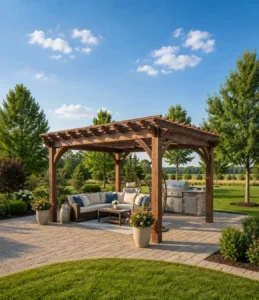
Thousands of Canadian homeowners type “pergola with a roof” into a search bar every year, and most of them are not really looking for a
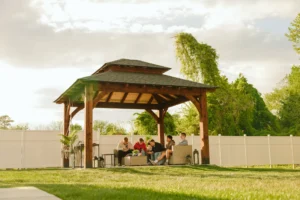
Two of the most popular outdoor structures in Canadian backyards are the pergola and the timber frame pavilion, and both are genuinely excellent choices depending
It looks like you're visiting from the United States. We have a dedicated US site for you.
Take me to the US site