
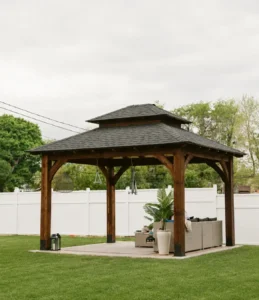
Pergola vs. Gazebo: Which One Actually Fits a Canadian Backyard
Planning a backyard upgrade in Canada usually brings homeowners to the same crossroads: a pergola or a gazebo. The pergola vs gazebo question looks simple




An outdoor kitchen represents a permanent and functional extension of a property. The covered structure built to house it must support that use reliably over the long term, and selecting the wrong structure at the outset carries real consequences for both performance and investment. At this level of commitment, the choice between a gazebo and a pavilion is not an aesthetic consideration. It is a structural one.
The gazebo vs pavilion question carries more weight than it initially suggests. For Canadian homeowners, the decision has direct implications for load capacity, ventilation, layout efficiency, and the long-term integrity of the build.
A gazebo is a decorative outdoor structure, typically round or octagonal in form, with a peaked roof, latticed sides, and lightweight framing. Its design prioritises visual appeal within a landscape setting. A pavilion is rectangular and open-sided, constructed with a solid roof over structural timber, and built for practical, year-round use.
The difference between a pavilion and a gazebo becomes significant the moment a permanent outdoor kitchen is part of the plan. A kitchen installation requires a structure capable of managing substantial weight, maintaining adequate airflow, and sustaining performance under the ongoing demands of an active cooking and entertaining environment.
A gazebo serves well as a landscape feature. An outdoor kitchen pavilion serves as a functional structure. For a project of this nature, structural suitability is not a secondary consideration.
A permanent outdoor kitchen introduces substantial combined weight to the structure that houses it. Built-in grills, stone countertops, refrigeration units, and plumbing fixtures place a load on the structure that a gazebo’s lighter framing and shallower footings were not designed to carry.
Ventilation presents an equally critical concern. A cooking environment produces heat and smoke continuously, and a gazebo’s enclosed or semi-enclosed perimeter has no adequate means of dispersing either. Insufficient airflow compromises comfort during use and raises genuine safety considerations when a grill is operating beneath a roofline that does not permit adequate ventilation.
The difference between a pavilion and a gazebo in an outdoor kitchen context is a matter of structural engineering. A pavilion is built to manage load, heat, and continuous use. A gazebo is not, and the limitations of that construction become increasingly consequential as the demands of a permanent kitchen accumulate over time.
A solid-roofed outdoor kitchen pavilion with fully open sides addresses ventilation requirements by design. Heat dissipates upward without obstruction. Smoke clears laterally. The environment beneath the structure remains functional and comfortable regardless of cooking duration or occupancy.
The rectangular footprint resolves the spatial demands of a kitchen with equal efficiency. Countertops, appliances, and storage can be positioned along one or both sides in a linear configuration, consistent with the organisational logic of a well-planned kitchen. There are no irregular angles to accommodate and no structural constraints on appliance placement.
Constructed from Grade No. 1 Douglas Fir, a timber recognised for its strength, dimensional stability, and resistance to moisture, a pavilion carries the combined load of a permanent outdoor kitchen without compromise. The material is built to perform over decades.
Effective kitchen design is inherently linear. Preparation, cooking, and service zones function most efficiently in a straight-line or L-shaped configuration, where circulation is clear and workflow is uninterrupted. A pavilion’s rectangular footprint supports both arrangements, giving the homeowner full control over the placement of each element within the space.
A gazebo works against this requirement. Its octagonal or round perimeter disrupts linear cabinetry runs, restricts secure appliance anchoring, and introduces angles that complicate both the design and the physical installation. In a gazebo vs pavilion assessment for kitchen use, this spatial limitation is frequently underestimated during planning and most evident once construction begins.
Ceiling clearance reinforces the same conclusion. A pavilion maintains consistent height across the full footprint, providing the clearance required for a ventilation hood, ceiling fan, and pendant lighting. A gazebo’s peaked interior narrows toward the centre, making proper extraction above a grill both technically difficult and visually incompatible with the structure.
Also Read:
Establishing the correct footprint at the planning stage is one of the most consequential decisions in an outdoor kitchen project. A structure that appears well-proportioned in plan frequently proves insufficient once appliances are installed, countertop surfaces are in place, and the space is in active use.
For a kitchen incorporating a built-in grill, preparation space, and seating for four to six, a minimum footprint of 14 by 16 feet is a practical baseline. Installations that include a sink, refrigerator, or dedicated dining area benefit from 16 by 20 feet or more, depending on the intended layout.
The NORWEH Timber Frame Pavilion HT (Heavy Timber) is available in sizes from 10 by 10 feet up to 24 by 26 feet wide. This range allows homeowners to size an outdoor kitchen pavilion around the kitchen they intend to build, rather than constraining the kitchen design to fit a structure selected before the layout has been properly considered.
Also Read: Top Outdoor Living Trends in Canada for 2026
NORWEH Timber Frame pavilion kits are constructed from Douglas Fir Grade No. 1 Structural and finished with CUTEK stain for long-term weather resistance. Every joint is factory pre-cut, assembly is designed for two people using standard tools, and both the Pavilion HT and Pavilion LT lines are delivered free across Canada with a 10-year structural warranty and a 100-day risk-free trial.
The open-sided configuration is well suited to outdoor kitchen applications. There are no walls to work around, no ventilation modifications required, and no structural adjustments needed to accommodate appliances or countertop installations. No additional modifications are required once the structure is assembled, it is ready to accommodate a permanent kitchen installation from day one.
NORWEH Timber Frame pavilion kits are designed for two-person assembly using standard tools, with no prior timber frame experience required. Every component arrives pre-cut, labelled, and sequenced, with factory-machined mortise and tenon joinery that ensures a precise fit at every connection point.
Also Read: How to Attach a Timber Frame Pavilion to Your House: Complete Guide
A well-built outdoor kitchen requires a structure that has been built for it. The gazebo vs pavilion decision comes down to whether the structure above the kitchen can meet the demands placed on it across load capacity, ventilation, layout, and long-term performance.
A pavilion meets those requirements. A gazebo does not. For Canadian homeowners planning an outdoor kitchen pavilion this spring, that distinction is the most important decision to resolve before anything else is considered.
Planning a backyard upgrade in Canada usually brings homeowners to the same crossroads: a pergola or a gazebo. The pergola vs gazebo question looks simple
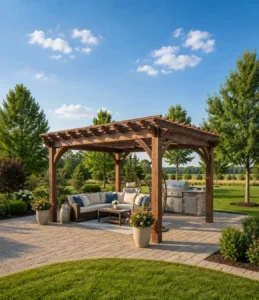
Thousands of Canadian homeowners type “pergola with a roof” into a search bar every year, and most of them are not really looking for a
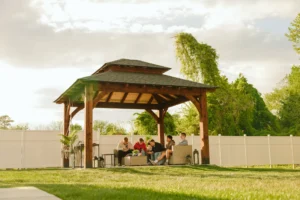
Two of the most popular outdoor structures in Canadian backyards are the pergola and the timber frame pavilion, and both are genuinely excellent choices depending
It looks like you're visiting from the United States. We have a dedicated US site for you.
Take me to the US site